 Skip to content
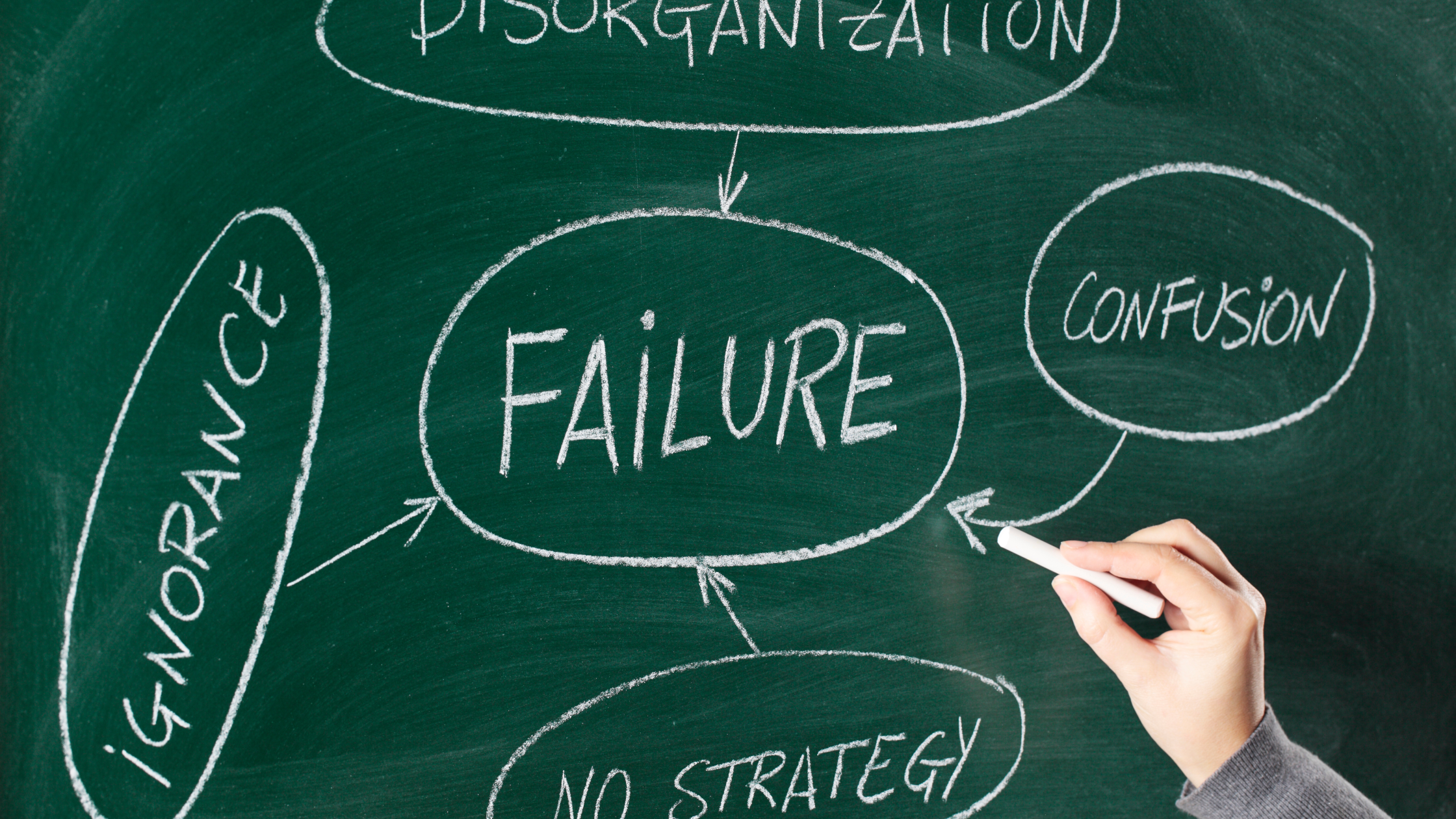
It usually starts with a complaint in a drawing room, at a tea stall, in a WhatsApp group, in a college room, or at a dinner table. Someone will start talking about a pothole that has been there for ages, a hospital that turned away a poor family, a job that went to someone’s nephew, a byelane that has become a nightmare to navigate, a temple that was built where a school should have been, a park that has been encroached, lack of green spaces in cities, powercuts, overflowing garbage on the streets, or something similar, and within minutes the conversation will converge on its familiar diagnosis: Corruption.
Something is rotten… the consensus would say.
Sometimes it is politicians. Sometimes it is bureaucrats. Sometimes it is the system. Most times, it is those people, and depending on who is speaking, those people could be any caste, religion, class, or party. The vocabulary may shift. The villains may rotate. But the diagnosis nearly always stays the same. It is they, not us.
We are very good at diagnosing symptoms and affixing blame. Unfortunately, we are spectacularly bad at finding the root cause. In this piece, we will dive in some detail on what we think are the problems versus what they actually are.
The Symptoms We Have Mistaken for Diseases
Let us be honest with each other for a moment. (Note: this kind of honesty rarely survives social settings, but should suit us here.) India’s problems, as most of us define them, run on a few familiar tracks:
Corruption. Reason numero uno for all ills, we say. Politicians sell their vote. Conglomerates swindle the weak. Contractors use more sand than necessary. Safety inspectors look the other way for a price. Traffic police pocket non-official fines. Government servants do not move a file unless some bribe moves into their pockets first. All reasons are true. But they are the symptoms of a more insidious disease.
Casteism. Millenials or Gen Z would not know of the Mandal Commission but the Gen X that took to the streets would remember their hour in the sun. Whichever side you stand on, you cannot deny that this insidious nomenclature of birth determines access to education, marriage, dignity, safety, justice, et al. even now for lakhs of people. Caste is not a relic or a figment from history. It is in today’s present and is volatile and active. From the self-righteous villagers in North or South India, to yuppies who post ‘Brahmin-genes’, and to the diaspora who wear this badge with pride, it is an identity that has been utilised to the hilt to goad and then rule over the masses.
Is caste the root cause of all problems or the biggest problem in India? No, it is not. This again is a symptom, created millennia ago for different reasons than the ones which give it credibility today.
Religious Bigotry. The holy cow that no one wants to debate to a conclusion. The ease with which a crowd can be assembled in the name of God to do things that God of any faith would be appalled by. The weaponisation of personal and social identity, or the festival that turns into an active act of provocation. The temple, the mosque, the church, all enlisted in a war none of them declared: all to serve the interest of a few who will benefit, maybe with more media exposure, maybe an election ticket, maybe more funds from the diaspora who want to save the nation by giving some token alms to protect the glory that was India.
Is this the reason for all ills or the source of all solutions? No again. Despite what religious leaders may have you believe.
Government Failure. The list of government failure is endless. For instance, our roads are akin to arteries that connect potholes. Highways and flyovers exist only on paper. Schemes exist only in an election speeches. Ministries move at the speed of a snail. Sports bodies are headed by politicians to make money and distribute favours. A Constitution that was brilliantly written but is catastrophically implemented in a free nation to serve the rulers. The rulemakers forget that before the name of the country is even mentioned in the Constitution, the first words it declares are “We, the people…” It does not say: “We, the government…”, nor “We, the judiciary…”, nor “We, the media…”
Unfortunately, the bad governance is a symptom of a larger ill. Bad rulers exist because they are not questioned about their duties. It is a big problem but certainly not the biggest.
The Immoral Media. This sector has perhaps failed Indians the most in recent times. We have studios that treat outrage as a product, manufactures it 24×7, sells it as news, and calls the transaction journalism. Intelligent people who seem holier than anyone else, putting themselves on a pedestal and perhaps preening in front of the mirror every day about their power and influence.
This is the one pillar of the nation that was open to all but which has become known for its lack of integrity. How can we respect an industry that does not have the self-respect to unite against the arm-twisting tactics of the powerful, or fight for those of their family who choose to speak the truth and paid the price? This is an industry that is globally ranked lower than its brethren in dictatorships. History will be more brutal to the cacophony peddlers than even the masters they serve.
But again, are they the main problem? We know they are not. They are not that powerful.
A Blind Justice System. There are enough failure stories of the judiciary in India. This is a system where the wealthy buy delay and the poor suffer injustice; where a man can spend years in an undertrial cell for a crime he did not commit; where bail is routine for the powerful and unthinkable for the powerless. A country where judges don’t like to be called corrupt but are friends with the political establishment, the very same group against whom they are supposed to safeguard the people. The laws are written for a colonised country and implemented in a free nation. ‘Ignorance of the law cannot be an excuse’, the law says, but you will find it difficult to unearth a lawyer or a judge who knows each law, rule, principle, or case law. But should the citizen know everything or suffer the consequences? Of course!
But are they the biggest headache India has? No. They are again symptoms of a larger problem.
A Bribe-Fuelled Bureaucracy. A system where duty is transactional at every level. Where the right to a ration card, a birth certificate, a land record, a pension, et al. must be paid for twice — once in tax and once in bribe. IAS or State Civil Services officers who sit at the head of district departments, and yet for nearly 80 years have not been able to weed out corruption from their offices. Do these civil servants choose civil services because they wanted to escape their own helplessness, or to serve the country? Have they been warned against the hubris and moral corruption beget by the trappings of power? Why do those who stand up to politicians find themselves transferred to remote postings? Why don’t bureaucrats have a sense of integrity and pride in their work? Has kowtowing to political leaders bent their spine? Shouldn’t the UPSC and state civil service exams be combined into one? Can a couple of tests and an interview decide the future capabilities of a greenhorn?
Yet, they are the result of a quesionable but powerful system. They exist and derive their power because of this system.
Language Divide. A country of twenty-two scheduled languages and hundreds of dialects, where the mother tongue can determine the ceiling of your ambition, where English fluency is not a skill but a class marker, where a child in a mother tongue-medium school and a child in a convent school inhabit different Indias entirely. And yet, woe betide anyone who says there are two or more Indias. A country where people are more interested in whose language is better, forgetting that language is for communication, to build bridges not barriers. Definitely, not the biggest problem.
Economic Disparity. Where eight people own as much as the bottom six hundred million. Where the gig economy worker and the hedge fund manager both live in Mumbai but might as well live on different planets. A country where the country’s per capita GDP is perhaps a proverbial slap on the face of every Indian, especially considering that it is as abysmally low now as it was during the Middle Ages (when India’s GDP was highest in the world and attracted Europeans to ‘only’ trade). The finance ministry provides tax-saving salves to help people forget their real-world poverty and then presents a tax returns form that no sane person should be able to fill.
This is an important problem, perhaps standing right behind the biggest problem.
Brain Drain. The best minds, nurtured at great national expense, board a plane at twenty-five and build someone else’s future. They don’t do this because they are unpatriotic but because the conditions here would crush them. They have seen their parents and grandparents being crushed. They chose differently. Why bother trying to change a system that has something rotten at the core: the ability of the powerful to suffocate the regular citizen at will. Where a local politician can promote himself by filing an FIR against an innocent man on the grounds of disrespect to national and social pride.
But is this the main problem? No, it isn’t.
This is a formidable list, and every item on it is real. Each deserves its own book, its own policy paper, its own protest movement.
But here is the question that first-principles thinking demands we ask before we do anything else:
Are these the causes? Or the effects?
Going to the Root: The First Principles Approach
First-principles thinking, i.e. the discipline of stripping away assumptions and inherited explanations until you reach the bedrock truth from which everything else is built, is brutally uncomfortable when applied to your own society. And to yourself.
Because what it tells you is this:
Every institution is made of people. Every system is made of people. Every corrupt bargain requires two people. Every act of bigotry is performed by a person. Every bribe has a giver and a taker, both of them people. Every politician who makes inflammatory speeches does so because someone listens and does not tell him to shut up.
So the question is not: what is wrong with the system?
The question is: what is wrong with the people who make the system?
And before you recoil at the implied misanthropy of that sentence, let me be precise: i am not asking what is wrong with us Indians as human beings. I am asking what is wrong with what we were given. What we were taught. What we were made into — by our families, schools, society, culture, our temples and mosques, our television channels, our social media feeds, and our friends and peers?
The questions come because here is what developmental psychology, neuroscience, sociology, and a few thousand years of human observation all agree on:
You are, in the most fundamental sense, the product of your genes and your childhood environment.
Not entirely. Not permanently. Change is possible — it is one of the most beautiful things about human beings. But you begin as the product of what you were given. And what most of us Indians were given, across class, across caste, across religion, is a childhood environment that failed us in specific, measurable, and catastrophic ways.
The institution most responsible for that failure has a name. It is the Education System.
We call it school and college.
The Great Indian Misunderstanding of Education
Ask any middle-class Indian parent what they want from their child’s school and college education. The answers are predictable and heartbreaking:
Good marks. Good rank. Good college. Good job. Good salary. Good match.
This is not a life philosophy; it is a factory line specification. One that treats children as products, rather than humans.
The Indian education system — from the pre- and colonial-era rote-learning framework we inherited and never dismantled, to the modern coaching-factory model that colonises childhood from age three or four — has one design goal: to produce a credentialled worker. Someone who can sit in a seat, absorb information, reproduce it on demand, and be useful to an economy.
This is not education. This is training. And even as training, it is increasingly mediocre. (And as AI experts cacophony through social media, traditional media and gaggable ads: AI can do better.)
But the deeper catastrophe is what it does not teach.
The Things School Never Taught You
This may be a highly uncomfortable list because it points to deeper malaises than exam paper leaks, but each point is true.
School did not teach you how to think. It taught you what to think, specifically: what to think to answer the exam questions. It did not teach you to question premises, to reason from evidence, to hold two contradictory ideas simultaneously and work out which one is closer to the truth. Critical thinking was not a subject. It was, if anything, actively discouraged by a system that rewarded correct reproduction and penalised deviation.
School did not teach you how to fail. In a country that treats academic marks as a proxy for human worth, failure carries an existential charge that it simply should not bear. Children who fail exams are treated as failures (i am not even going into the tragedy of student suicides here). The result: a generation of adults who are terrified of being wrong, who cannot admit mistakes, who confuse the ego with the truth, who would rather double down on a bad decision than admit they made one. Think of it this way: how many government officers do you know who admit there is something wrong with their way of working? Bureaucrats would rather take bribes like their predecessors than own up to the fact that they have been turned into failures.
School did not teach you self-awareness. Nobody sat you down and said: here is how your mind works. Here is how your emotions influence your decisions. Here is how your biases (and all of us have them) distort your perception of reality. Here is how to watch yourself think. Here is the difference between a feeling and a fact. Here is what solitude is for. The examined life that Socrates considered the only one worth living was not part of the curriculum. The result is 1.5 billion people who are busy disseminating their self-righteousness to anyone and everyone, while being completely ignorant of themselves.
School did not teach you civic responsibility. Not as an abstraction, not as Chapter 3 of the Constitution, not as answer to question no. 7 in the exam, but rather as everyday practice: this road is yours, this park is yours, this river is yours, the person sleeping on the footpath is your moral concern. The garbage you just dropped: pick it up. The queue you just cut: you just told the person behind you that your time is worth more than theirs. What gives us that right? A school system that does not teach about tolerance for a little personal discomfort in order to serve a greater good will never create responsible citizens. The world will have to deride and laugh at us before this sense even starts to sink in.
School did not teach you self-discipline. Real self-discipline; not the coerced compliance of the uniformed child who will be punished for speaking out of turn, but the internally generated, autonomous discipline of the adult who makes hard choices because they align with their values. The ability to delay gratification. To resist the comfortable lie. To do the difficult thing because it is right and not because someone is watching. A society that follows traffic rules is one that will survive and thrive because they are willing to put in the effort to create a better quality of life for all. A country where people drive on the wrong side of the road is not a country going anywhere but down.
School did not teach you courage. The courage to stand in a crowded street and tell a mob that what they are doing is wrong. The courage to refuse a bribe even when refusing costs you. The courage to report your colleague, your neighbour, your relative, your priest when they do something genuinely wrong. Moral courage, which is the rarest and most important type of courage, was never mentioned in school curricula. For the few who learnt, it was a personal journey, not one taught in schools.
School did not teach you empathy. Not the saccharine version, not the Mahatma Gandhi, Swami Vivekanand, or Mother Teresa poster on the classroom wall, but the hard, practical, daily empathy that asks: what is it like to be the person across from me? What is this SC/ST/OBC/Dalit/economically weaker student experiencing in my classroom? What is it like to be a woman in this street at night? What is it like to be born in the wrong village, to the wrong family, speaking the wrong language? Empathy is not a sentiment. It is the cognitive and moral capacity to expand your circle of concern.
Every identity-based atrocity in human history happened when empathy did not exist. It is good to remember here that the moral corruption of Rome is said to have been a reason for its downfall. When people become apathetic, countries fall. Look at Nazi Germany if you want a recent example.
School did not teach you about money. Not economics as a subject. Not GDP formulae and balance of payments. But the personal, practical relationship between human beings and financial resources. Things such as how to save, how to spend, how debt works, how compounding works, how economic desperation makes people do things they would not otherwise do, and how financial literacy is the single most consistent predictor of freedom in adult life. Teach a person how to save and grow their money and the world will become saner.
School did not teach you your own history honestly. It taught you a version of history that was curated for nation-building, scrubbed of complexity, drained of nuance, and stripped of the parts that might make you uncomfortable. A history that does not honestly acknowledge the repercussions of regional triumphalism, religion-fueled atrocities, caste violence, collaboration of elites with colonisers, how ordinary people participated in extraordinary injustice, is a history that will never produce citizens who understand how injustice works and how to resist it. At the core of it is the contention that nation-building needs scrubbing, not realising that scrubbing does not help people see what was right and what was wrong in our history. Only this insight will help us accept who we are and decide to choose what is right, which in turn, will build a stronger nation.
Everyone Loses When Religion Replaces Ethics
(This has its own section because it is a very important topic.)
Many Indian children receive some form of moral instruction: in the morning assembly, in religious education classes. At home. In the temple, mosque, gurudwara, church.
But here is the problem: morality taught as religious compliance is not morality. It is obedience.
Do not lie — because God is watching, and God will punish you.
Do not steal — because the karma will come back to you.
Be kind to the poor — because you will get merit in the next life.
Respect your elders — because that is what our tradition says.
These are not moral arguments but transactional instructions dressed in spiritual garb. And the moment the transactional equation shifts, the moment someone believes that no one is watching, or that the karma can be offset by temple donations, then the entire moral foundation collapses because it was never built on genuine moral reasoning, but rather on compliance and reward. (Social scientists argue that this lies at the core of our inability to solve problems.)
Moral reasoning, the type that produces citizens who behave well in the dark, who hold the line when holding it costs them, who treat strangers with the same consideration they treat their family, is built differently. It is built through a process that asks: why is this wrong? And accepts no answer that begins with because God said so or because our tradition says so.
Why is corruption wrong?
Because it is unethical. It diverts resources from people who need them to people who do not. Because it is an unjust tax on the vulnerable. Because it corrodes the trust that makes societies function. Because every rupee in a government official’s pocket is a vaccine that was not administered, a textbook that was not printed, a child going hungry, a school that did not have an honest teacher. There is an economic cost to this transactional morality. And they add up.
These are moral arguments that children should be taught.
Instead, we taught them to be afraid of the divine. And when the fear fades (and it fades in most adults somewhere in their twenties), nothing replaces it. No principle, reasoning, or deeply held conviction that the right thing should be done regardless of who is or isn’t watching.
The result is a society full of adults who are religious and immoral simultaneously. Those who perform the ritual and then go back to cheating, who fast on Ekadashi and bribe on Monday, who listen to the Gita or Koran and don’t realise they were written for people who were ignorant and illiterate, and needed simpler explanations for complex questions. A school system that does not teach children how to think deeply will never go beyond the surface level text of these books and fail to see the kindness and self-awareness that lie at their core.
You Are Not Born Corrupt. You Are Made That Way
This is the most important insight in this entire essay, and you should sit with this thought for a moment.
The child who grew up watching his stoplight-jumping father offer five hundred rupees to the traffic constable so that the family did not have to be inconvenienced learned something that day. He learned that rules are only for people who cannot afford to break them. He learned that the system is a negotiation, not a structure. He learned that the right move — the intelligent move — is to work around the rule, not within it.
He was not taught this. It was not in a textbook. It was transmitted through observation, through imitation, through the accumulated weight of lived example. And that lesson, absorbed at seven or eight years old, will shape how he operates at forty.
The girl who was told, in school and at home, that her purpose is to be a good daughter and then a good wife and then a good mother learned something about her own worth. She learned that her inner life — her ambitions, her questions, her dissatisfactions — is secondary to her relational functions. She learned, in the deepest possible way, that she is instrumental rather than intrinsic.
She was not taught this in a direct lesson. She was immersed in it, through curricula that kept women in supporting roles. Through teachers who called on the boys first. Through textbooks where scientists, leaders and explorers were all, somehow, men. Girls see that they are categorised as daughters, wives, mothers and grandmothers — never as an individual. What is lost in the process is a tragedy beyond words. We have silenced the more resilient and practical half of the human species. What hope do we have of creating a better society?
The boy from the dominant caste who was never made to truly confront what that dominance has meant, historically and practically, for the people his community has oppressed, grew up with an understanding of fairness that has a convenient blind spot at its centre. He is not a monster. He was never equipped with the tools to see what he might otherwise have seen.
You cannot be better than what you were given unless someone, somewhere, gives you something better.
That is what education is for.
What Education Means in First Principles Thinking
The word education comes from the Latin educare — to draw out, to lead forth. Not to pour in. Not to fill up. Not to credential. To draw out what is already within.
Real education, in its oldest, most rigorous sense, is the project of making a full human being. Not a unit of economic production. Not a religious devotee. Not a bearer of cultural tradition. A full human being, capable of:
- Thinking clearly: following an argument, spotting a fallacy, distinguishing between evidence and assertion, maintaining a position under pressure, and abandoning it under evidence.
- Feeling correctly: naming your emotions, understanding what drives them, not being ruled by them but not being severed from them either, extending your emotional imagination to include people unlike yourself.
- Acting with integrity: in alignment with genuinely held values, consistently, even when consistency is costly, even when no one is watching.
- Contributing deliberately: understanding that you live in a web of relationships and institutions that depend on the quality of each person’s participation, and taking that responsibility seriously.
- Growing continuously: treating yourself not as a finished product but as an ongoing project, capable of revision, improvement, and repair.
You may think this is idealism, but it is not. It is actually a design specification for the kind of adult that makes a society work.
And almost none of it is taught in Indian schools.
The Underlying Problem
The larger unseen problem with education is something called the Education Cycle. You may even say, it lies at the core of the problem. This problem is not only Indian, it is global, and yet no one talks about it since it remains lost amidst nostalgia and the self-righteousness of those in power.
What the Education Cycle means is that the curriculum that is being taught to kids at present was created by adults who were educated under different circumstances. Their world was different, rules were different, social norms were different. These people who wrote the books for today’s kids read books written by people 2-3 generations older than them.
Ask any 50+ years old senior official today – in politics, bureaucracy, judiciary, media, in international corporations, in educational systems – about what they were taught, and you will get a completely different worldview and education from the present. And since our childhood and young adult years form the bulk of what we believe we have learnt and take as gospel, these senior officials find it hard to detach themselves from their formative years when they face current situations. The social environment also plays a role in deciding their thought foundations. This is why the books they write and the curricula they devise feel so out of place in the modern world. The world for which they are writing and creating education systems no longer exists.
The writers and education system officials are coloured by what they were taught as the truth. No wonder parts of history are expunged, rote learning is still in place, schools and education boards worship exams, and irrelevant college entrance tests still exist.
Technology right now is advanced enough that IITs can partner with local colleges and smaller universities to break down admission barriers. They can train the lecturers and professors on IIT pedagogy and allow students of these other institutions to learn from the IITs through distance classroom learning. However, this is not happening or even in the works. Why do you think that is?
I have covered this more in my book, The Religion of Life. (This is a shameless plug because i genuinely believe you will benefit. If you want to read the book, it is available on Amazon as an ebook and on Kindle Unlimited, among others.)
The Compounding Catastrophe
Here is why this matters so urgently, and why the education failure is not just one of many Indian problems but is foundational to all of them:
The effects of an education system compound — exactly like interest, but in reverse.
- A child who is not taught to think critically becomes an adult who cannot evaluate a political speech and who therefore votes based on identity, not past records or results achieved or not.
- An adult who votes on identity elects a politician who governs on identity.
- A politician who governs on identity has no incentive to build institutions because institutions require citizens who hold them accountable, and citizens who vote on identity don’t.
- Institutions that are not held accountable become corrupt.
- A corrupt institution requires bribes to function.
- A citizen who learned in childhood that rules are negotiable pays the bribe. His child sees this and learns something.
Now try the same chain with civic responsibility:
- A child who was never taught that public spaces are a shared responsibility becomes an adult who drops garbage on the street.
- An adult who drops garbage on the street does not vote for an MLA or mayor who builds better waste management because the adult does not believe that public infrastructure is connected to his personal behaviour.
- An MLA or mayor who does not face accountability for public services does not build them.
- A city without functional waste management produces disease.
- Disease falls hardest on the poor, who cannot afford to live away from it.
- The poor, badly educated themselves, do not organise to demand better because organisation requires literacy, civic understanding, and the belief that your voice matters.
Now, run it with gender:
- A girl who is taught that her value is relational, as daughter, wife, mother, internalises a diminished sense of her own authority.
- A woman who does not believe in her own authority does not stand up when she should. Does not report. Does not resist. Does not run for office. Does not lead.
- A society where women do not lead at full capacity operates at half its potential.
- Half-capacity societies are poor societies — in every sense of the word.
Follow the process in every chain of events, every seemingly intractable Indian problem, and you arrive at the same place: a person who was not equipped by the education they received to be the citizen that a functioning society requires.
Now Let’s Come to the Really Hard Part
Everything i have written so far is systemic. It is about institutions, curriculum, culture, and policy. It gestures at governments and policymakers, and school administrators and reformers.
That is necessary. But it is incomplete.
Because here is how real change has always happened in human history: it has never started with institutions. It has always started with individuals who decided to be different.
The most important thing to take away is this:
If you are reading this, this means you are one of the educated ones. And that comes with a burden.
Not the burden of guilt. Guilt is useless, self-indulgent and paralytic.
I am referring to the burden of responsibility. The responsibility to close the gap in yourself first, and then in your family, maybe in your circle, and then in whatever institution or community you touch.
Because you can give yourself and the next generation whatever the Indian education system failed to give you. The material exists. So does the opportunity. And unlike previous generations, you do not have the excuse of inaccessibility. The entire accumulated wisdom of humanity — every bit of science, arts, commerce, philosophy, psychology, moral frameworks, and every mistake of history — is available to you at a cost that is essentially zero.
The question is not whether you can access it.
The question is whether you choose to.
The Mirror Test
I want to ask you something, and i want you to answer it honestly to yourself, in the stillness that honest self-examination requires.
When you are alone — genuinely alone, not performing solitude on a wellness retreat, but actually alone in the 2 a.m. version of yourself that has no audience — what do you see?
- Do you see someone who thinks carefully before forming an opinion, or someone who has inherited opinions and defends them as though they were their own?
- Do you see someone who treats the people around them — the domestic worker, the delivery driver, the security guard, the autorickshaw driver — with the same fundamental respect they show their boss, their in-laws, their peer group?
- Do you see someone who has examined their own biases around caste, around gender, around religion, around class and done something about them? Or someone who performs progressiveness in public and maintains prejudice in private?
- Do you see someone who takes care of their body, their mind, their relationships, their surroundings with the quiet, undramatic discipline of someone who understands that self-respect is enacted in small daily choices?
- Do you see someone who speaks less and does more? Who has opinions but also has actions? Who does not outsource the moral responsibility for their society to politicians and influencers while doing nothing themselves?
These are not comfortable questions. I know this because they are questions i asked myself. And honestly, the answers were not flattering.
But this is what self-awareness is. This is what the education system should have given you: the habit of honest self-examination. The willingness to look clearly at what you find, without flinching, without flattering yourself, without immediately reaching for the comforting narrative of external blame.
The corrupt politician you despise was someone’s student, someone’s child, someone’s friend. He was someone, once, with the same open and unformed potential you once had. What was done with that potential (and more importantly, what was not done) made him what he has now become.
You are still making what you will become.
The Arithmetic of a Life
Here is the number i want you to carry with you:
36,525.
That is the number of days in a hundred-year life. And most of us will not get a hundred years.
Against the backdrop of the universe — 13.8 billion years old, home to two trillion galaxies, operating on timescales that make the entirety of human civilisation look like a rounding error — you are allotted a cosmic instant. The difference between your life and no life at all is, by cosmic measure, approximately nothing.
And yet here you are. Sentient. Self-aware. Capable of love, reasoning, creativity, and moral courage. The only life form we know of that can look at the universe and ask: what does it mean? What should I do with this?
That is not nothing. That is perhaps the most remarkable thing we know of.
So what do you do with the 36,525 days?
You can spend them producing and consuming and scrolling and complaining and blaming. Most of us do. The system invites it; the media is built for it; the algorithms profit from it. It is, in the most literal sense, the path of least resistance.
Or.
Or you can spend them becoming. Continuously, stubbornly, unglamorously becoming.
A better thinker. A more honest person. A more empathetic neighbour. A more disciplined worker. A more courageous citizen. A more present parent. A more self-aware human being.
Not for the legacy — though honestly, legacy is not nothing. Not to be seen — though being seen is not nothing either. But because the internal experience of becoming is the fullest form of being alive that human beings have access to. Because the alternative — standing still, blaming the system, waiting for a politician or a policy or a messiah to fix what is fundamentally a question about how you choose to live — is to squander the rarest resource in the known universe:
Your consciousness. Your time. Your singular, non-replicable life.
The Individual is the Unit of Change
This is the conclusion that first-principles thinking demands, and it is both empowering and unnerving:
India’s problems will not be solved by a new government, let alone the existing one.
Not because governments don’t matter. They do, enormously. But because governments are made of people. Bureaucracies are made of people. Courts are made of people. Corporations are made of people. Hospitals and schools and media houses and NGOs and neighbourhood associations and families are all, at their most granular, made of individual human beings who make individual choices, thousands of times a day, that accumulate into what we call the system.
You cannot fix the system while leaving the people unchanged. And you cannot change the people while leaving education unchanged.
But you can start with yourself. You can take the education you were denied and give it to yourself through reading, through reflection, through the practice of deliberately examining and revising your assumptions. You can take the civic sense you were not taught and enact it anyway — in how you drive, in how you queue up, in how you treat the person who serves you. You can learn the moral courage you were not taught and exercise it, maybe in small ways first, then larger ones, building the muscle that will otherwise atrophy from lack of use.
And then — and this is the part that compounds in the right direction — you can refuse to replicate the failure with the people around you. In how you raise your children. In what you model for them rather than what you preach at them. In the conversations you have with your students, your employees, and your younger siblings. In why you vote for a good person. In whether you choose to speak up when speaking up costs something.
This is not some inspirational poster optimism. This is the hard, slow, structural work of civilisation-building which has always happened one person, one decision, one day at a time.
What We Owe Ourselves and Each Other
The education system failed most of us. Some more than others like the children in a government school with no teachers, or those in a madrassa with no science subjects, or the ones in a convent school with no discussions about the Inquisition. In one way or another, it has failed almost everyone.
That failure is not your fault. You were a child. You took what you were given.
But you are no longer a child.
And the continuation of that failure — the decision to remain exactly who that system made you, to reproduce its blind spots and its silences and its comfortable evasions — that is a choice. And it is yours.
So choose.
Choose to be curious rather than certain.
Choose to be uncomfortable rather than stagnant.
Choose to extend your care beyond your immediate circle: to your street, your city, your country, the human beings whose lives your choices affect, even when you never meet them.
Choose self-discipline, not the punishing, joyless version, but the version that is an expression of self-respect: I will take care of my mind. I will take care of my body. I will take care of my relationships. I will take care of my environment. Not because someone is watching. But because I am absolutely amazing.
Choose honesty, directed first at yourself. The admission that you do not know. That you were wrong. That your opinion is an inheritance, not an achievement. That the story you tell about yourself is, in parts, flattering fiction.
Choose moral courage. The kind that stands in the street, or in the office, or at the dinner table, and says: this is wrong, and I will not pretend otherwise, regardless of the social cost.
Choose, in the deepest sense, to be educated.
Not credentialled. Not trained. Not merely informed.
Educated. In the old sense. Drawn out. Made fuller. Made more capable of seeing clearly and feeling accurately and acting with integrity.
Do all of this because India does not need a better political class: they are just us in power or in the opposition. India needs better citizens. And the only way to get better citizens is through better education. And the only place better education starts right now, today, for you is with the decision to educate yourself.
The classroom let you down. The system let you down. The politicians let you down. The media let you down.
That was yesterday.
Today is yours.
What do you choose to do with it?
In a trillion years of universal time, your 36,525 days are a whisper. Make them say something worth hearing.
Share this if it made you think. More importantly, let it make you act.
About the Author
Chirantan P.B is the author of The Religion of Life. He writes about first principles thinking, psychology, philosophy, and the interconnectedness of them all.
